AI-Native Contract Management: Future of SaaS Procurement
AI Contract Management, SaaS Procurement, Digital Transformation
The Future of SaaS Procurement: Why Your Next Contract Management Tool Must Be AI-Native
For CTOs, IT leaders, procurement professionals, and operations executives, the contract stack has quietly become a strategic risk surface. In 2026, sticking with a “digital filing cabinet” for contracts is no longer defensible. Your next contract management decision needs to be about AI-native capability, not just storage or e-signature add-ons.
The Problem with Legacy “Digital Filing Cabinet” Systems
Most legacy contract management systems were designed for one job: store PDFs and make them searchable by filename or folder. They solved the paper problem, but they never solved the intelligence problem. Contracts are still:
Hard to interrogate at scale (you still need humans to open and read them)
Disconnected from ERP, CRM, and procurement workflows where decisions actually happen
Blind to risk exposure, renewal cliffs, and non-standard terms until someone manually checks
The result is familiar: finance asks for all contracts with a specific vendor, legal wants to know which MSAs include a certain indemnity, procurement needs current rate cards. Your team exports spreadsheets, hunts through folders, and pieces together answers by hand. Deloitte estimates that fragmented agreement processes can destroy value at global scale, contributing to what they call the “agreement trap”—up to trillions in lost value when contracts are not operationalized effectively (Deloitte, 2026).
Repository Software vs. AI-Native Platforms: A Structural Difference
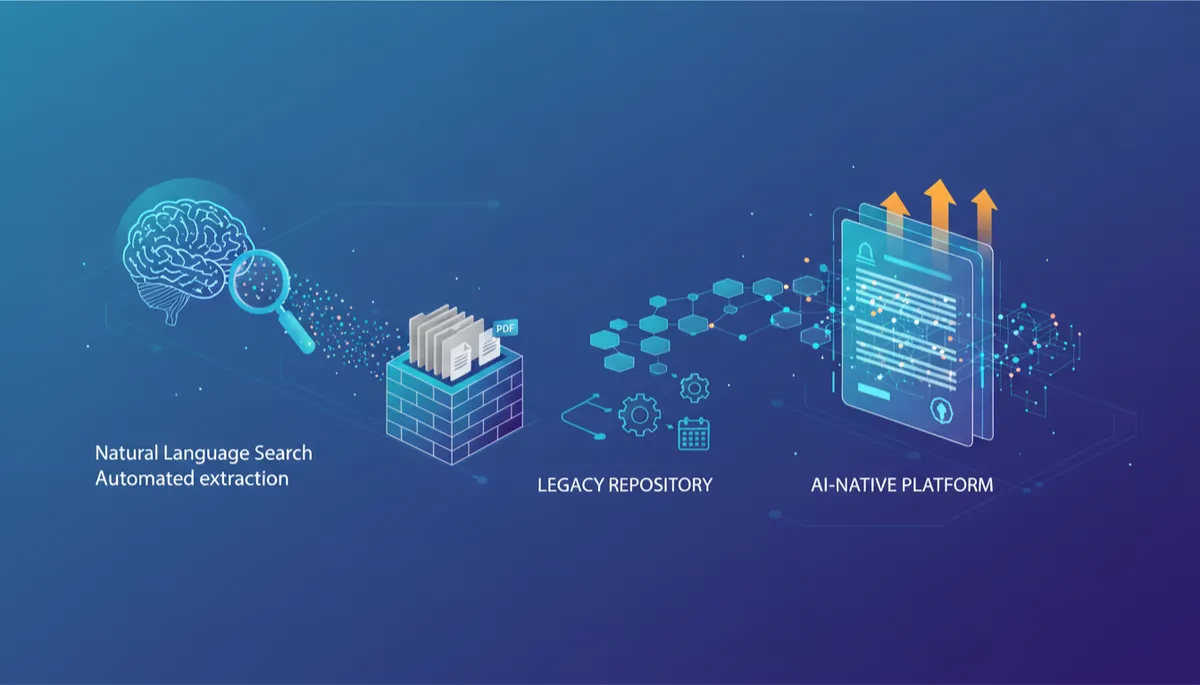
Many tools on the market today are still fundamentally repository-first: they manage workflows and storage, then bolt on AI for point features like clause extraction or redlining. They can be powerful, but the architecture is still workflow-native with AI as a layer on top (Bind Legal, 2026).
By contrast, AI-native platforms are built the other way around. The core of the system is an AI engine that:
Understands contract language using advanced NLP and large language models
Structures and enriches data as it ingests documents, not as an afterthought
Orchestrates workflows across CLM, CRM, ERP, and procurement tools as an agentic assistant, not just a passive database
This distinction matters. As Gartner and Deloitte note, the question has shifted from “does it have AI?” to “is the platform fundamentally AI-first or is AI just an add-on?” (Gartner, 2026).
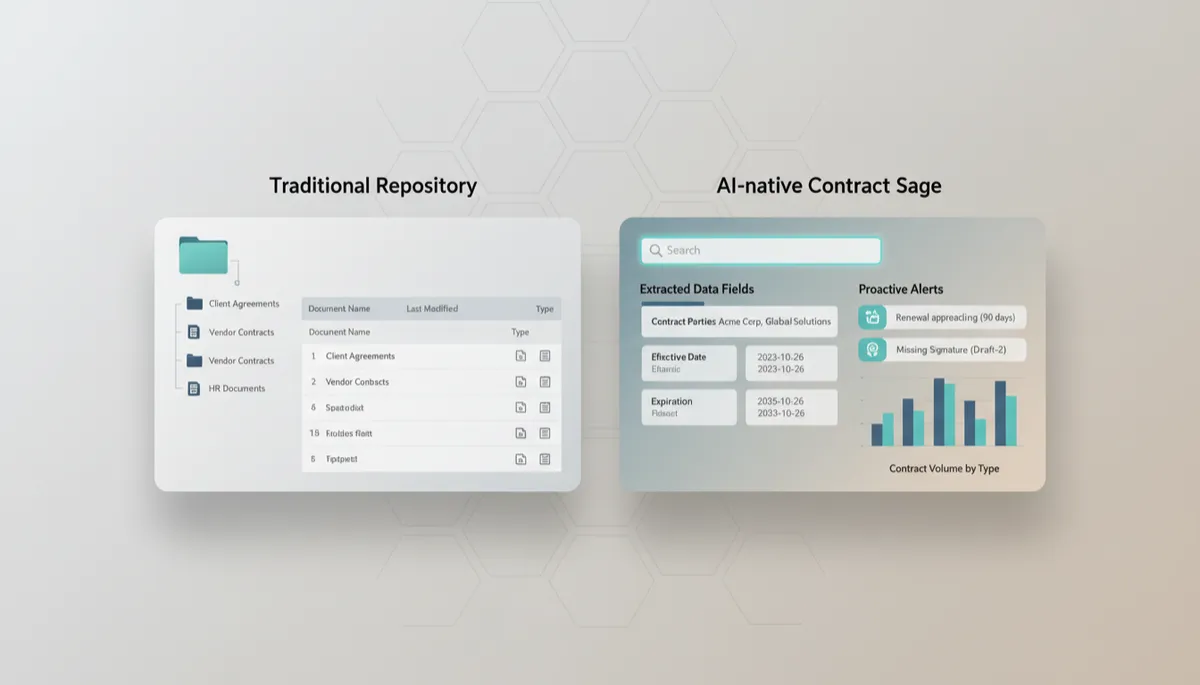
Moving from static storage to AI-native intelligence turns contracts into live operational data.
Why Natural Language Search Is Now Table Stakes
For modern procurement and operations teams, keyword search is no longer enough. You need to ask: “Show me all SaaS contracts with auto-renewal over 10% uplift where data residency is outside the EU.” That is a business question, not a filename query.
AI-native tools like Contract Sage use natural language processing to interpret these questions, map them to structured contract data, and return precise, explainable results. This is the difference between “searching for documents” and “searching your contractual reality.” In a world where 56% of procurement teams struggle to find current vendor terms and rate cards (Deloitte, 2026), natural language search is no longer a nice-to-have—it is a risk-control mechanism.
Automated Extraction: Turning PDFs into Live Data
Leading studies show AI now reliably parses contracts, automatically extracting parties, dates, renewal terms, SLAs, pricing models, and obligations—even from unstructured PDFs (Yenra, 2026). This automated extraction is the engine that transforms your repository into a live dataset you can report on, monitor, and act against.
Contract Sage’s AI-native pipeline ingests every new agreement and legacy document, normalizes clauses, and maps them to a consistent data model. That means your team no longer spends hours keying fields into spreadsheets. Instead, they review and validate what the AI has already surfaced—aligning with Deloitte’s findings that organizations using AI in CLM see around 36% efficiency gains and 29% labor savings (Deloitte, 2026).
Proactive Alerting: From Static Records to Always-On Monitoring
In 2026, simply “having the data” is not enough. Procurement and operations leaders need agentic AI that continuously monitors obligations, renewals, and risk signals and then acts within defined guardrails. PwC reports that 66% of organizations using agentic CLM platforms see measurable productivity improvements (PwC, 2026).
Contract Sage’s proactive alerting is designed for this new reality. Instead of a calendar reminder buried in someone’s inbox, the platform can:
Flag auto-renewals 90 days out with context on spend, usage, and alternatives
Escalate non-compliant data processing terms when regulations change
Notify contract owners when SLAs are at risk based on operational metrics
This is what transforms contract management from a passive archive into a live control tower for your SaaS estate.
How Contract Sage’s AI-Native Architecture Understands Context
Context is where legacy tools fall down. They might know a field is called “Term,” but they do not understand how that term interacts with pricing tiers, data residency, or your internal approval policies. Contract Sage is built on an AI-native architecture that models:
Relationships between clauses (e.g., renewal language plus notice period plus price uplift)
Cross-document context across MSAs, DPAs, SOWs, and addenda for the same vendor
Your organizational policies, playbooks, and preferred positions to evaluate what is “standard” versus “exception”
This contextual understanding lets the platform not only read contracts but also reason about them—surfacing what actually matters to your business, not just what appears on the page.
Automatically Extracting Critical Data Points That Leaders Care About
For CTOs, procurement, and operations, “critical data points” are not just signature dates. They are:
Renewal mechanics, notice periods, and uplift caps
Termination rights tied to uptime, security incidents, or M&A events
Data residency, subprocessors, and audit rights for SaaS and cloud vendors
Commercial levers like volume discounts, ramp schedules, and most-favored-nation clauses
Contract Sage automatically extracts and normalizes these elements into structured fields, ready for reporting and integration. That means you can answer questions like, “What is our total exposure to auto-renewing SaaS contracts above $250K in the next two quarters?” in seconds, not weeks.
Seamless Integration into Daily Workflows, Not Another Silo
The real value of AI emerges when it is embedded into the workflow, not when it lives in a separate portal your teams rarely open (TechRadar, 2026). Contract Sage is designed to sit where your teams already work:
Surfacing contract context directly inside your ERP or procurement suite when a purchase request is raised
Enriching CRM records with key terms so account teams know renewal risk and upsell levers instantly
Delivering alerts and insights into collaboration tools your teams already use, instead of forcing new habits
For technology leaders, this means Contract Sage becomes an intelligence layer across your SaaS ecosystem—not another system of record to maintain and adopt. For procurement and operations, it means fewer swivel-chair moments and more decisions made with full contractual context at the point of action.
The Procurement Imperative: Choose AI-Native or Fall Behind
Studies from Icertis and Deloitte show that more than half of organizations are moving from AI experimentation to real deployment in contract management, with over 95% of those not yet using AI actively planning adoption (Icertis, 2026; Deloitte, 2026). The competitive gap will not be between “AI” and “no AI”—it will be between AI-native platforms like Contract Sage and legacy repositories that simply cannot keep up with the pace of risk, regulation, and SaaS sprawl.
📌 Key Takeaway: When you evaluate your next contract management tool, do not just ask what it can store. Ask what it can understand, extract, alert on, and integrate—and how seamlessly it can turn your contracts into a live, AI-powered asset for procurement, IT, and operations.

